
How to Qualify Sales Leads and Drive Revenue from WhatsApp
When you're selling on a platform like WhatsApp, it can feel like you're trying to drink from a firehose. Inquiries are flooding in, but how many of them are actual opportunities versus dead ends? This is where mastering how to qualify sales leads becomes your single most valuable asset.
It's what transforms your process from a reactive scramble into a proactive strategy.
Stop Chasing Unqualified Leads on WhatsApp
Without a solid qualification process, your reps are just wasting time—countless hours spent on conversations that go nowhere. They end up chasing leads who have no budget, aren't the decision-maker, or just don't have a problem your product can actually solve.
This isn't just inefficient; it's a direct path to a frustrated team, dwindling morale, and stagnant revenue. The cost of not qualifying leads is steeper than most people realize.
The True Cost of Skipping Qualification
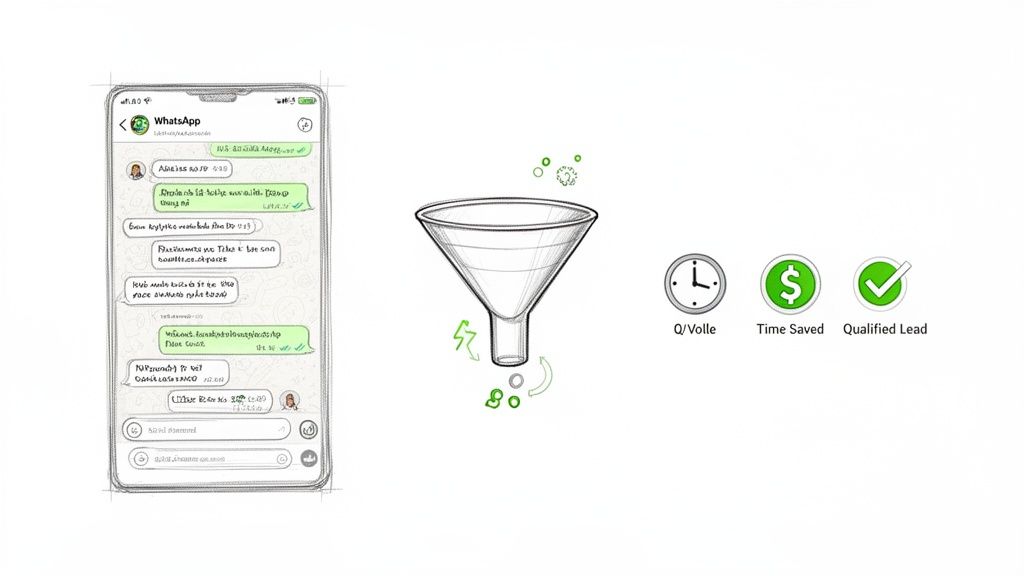
Think of it this way: every single minute your team spends talking to an unqualified lead is a minute stolen from a real, potential customer. That opportunity cost adds up fast, creating a leaky pipeline where valuable prospects slip through the cracks while your team is completely distracted.
Putting a disciplined approach in place fixes this. It creates a clear filter.
The numbers paint a pretty stark picture. Companies that get lead nurturing and qualification right generate 50% more sales-ready leads at a 33% lower cost. On the flip side, a staggering 79% of marketing leads never convert to sales, and a huge reason for that is the lack of a proper qualification process.
When you don't qualify, you're basically letting unqualified prospects dictate your team's entire schedule and priorities. A structured process puts you back in the driver's seat, making sure your most valuable resource—time—is invested wisely.
Let's look at the real-world difference this makes.
The Real Impact of Lead Qualification
Here's a quick comparison showing the stark differences between teams that qualify leads versus those that don't. The impact on key business metrics is hard to ignore.
| Metric | Without Qualification | With Qualification |
|---|---|---|
| Sales Team Productivity | Low; reps waste time on dead-end conversations | High; reps focus only on high-potential leads |
| Lead Conversion Rate | Very low, often below 2-3% | Significantly higher, often 10% or more |
| Sales Cycle Length | Long and unpredictable | Shorter and more consistent |
| Revenue Predictability | Unreliable; forecasting is a guessing game | Reliable; pipeline is filled with viable opportunities |
| Team Morale | Low; constant rejection and wasted effort | High; reps close more deals and hit targets |
The contrast is clear. Qualification isn't just a "nice-to-have"—it's a foundational element of a successful sales engine.
From Chaos to a Predictable Pipeline
Implementing a repeatable qualification system is how you turn those scattered WhatsApp chats into a predictable sales pipeline. It gives your reps a clear framework for every conversation, empowering them to quickly identify the best leads and move them forward.
This structured approach is fundamental if you're serious about learning how to manage sales leads effectively and building a sales operation that can actually scale.
This guide will show you exactly how to build that system. We'll walk through proven qualification frameworks, give you actionable scripts for WhatsApp, and even show you how to automate the whole process in a CRM. By the end, you'll have a clear roadmap to stop chasing dead ends and start turning more of those chats into revenue.
Choosing Your Sales Qualification Framework
Before your team can start qualifying leads on WhatsApp, they need a playbook. A sales qualification framework gives them just that—a consistent, repeatable structure for every conversation. It's the difference between structured selling and just winging it.
Without a solid framework, reps are left guessing what to ask, which leads to inconsistent qualification, deals slipping through the cracks, and a leaky pipeline. Think of it as a shared language for your entire sales team, ensuring everyone is on the same page about what makes a lead worth pursuing.
BANT: The Timeless Classic
You've probably heard of BANT. Developed by IBM ages ago, it's one of the most straightforward models out there, and its simplicity is why it has stuck around for so long. It's a great starting point for teams new to structured qualification.
BANT gets straight to the point with four core pillars:
Budget: Can they actually afford your solution?
Authority: Are you talking to the person who can sign the check?
Need: Do they have a real business problem that you can solve?
Timeline: How soon do they need to find a fix?
BANT works incredibly well for businesses with shorter sales cycles and less complex products. Imagine you're a small agency selling a standard website design package. A lead pops up on WhatsApp. With BANT, you can quickly find out if they have the budget, if you're speaking to the owner, and if they need a new site up by the end of the quarter. Simple, fast, and effective.
CHAMP: The Customer-Centric Alternative
While BANT is efficient, its budget-first approach can sometimes come across as a bit aggressive, especially in today's relationship-driven market. That's where CHAMP comes in. It's a modern take that flips the script to put the customer's pain points front and center.
Here's the breakdown for CHAMP:
Challenges: What specific problems are they trying to solve? Start here.
Authority: Who else is involved in making this decision?
Money: What's the budget for tackling these challenges?
Prioritization: How urgent is this compared to their other initiatives?
By leading with Challenges, the conversation immediately shifts to the prospect's world. This small change makes a huge difference. It positions your rep as a consultant trying to help, not just a salesperson trying to hit a quota. This is perfect for any consultative sale where truly understanding the customer's situation is the key to closing the deal.
Once you get a prospect to see the true cost of not solving their problem, the budget conversation becomes a whole lot easier. Suddenly, finding the money for your solution moves way up their priority list.
MEDDIC: For Complex Enterprise Deals
When you're navigating the choppy waters of high-stakes, complex B2B sales—think six-figure contracts and a dozen stakeholders—you need something more robust. Enter MEDDIC. This framework (and its variations like MEDDICC/MEDDPICC) brings the rigor you need to manage these intricate deals from start to finish.
MEDDIC digs deep into the business case:
Metrics: What are the tangible, economic benefits of your solution? We're talking hard numbers, like "increase revenue by 15%" or "reduce operational costs by 20%."
Economic Buyer: Who holds the purse strings? This is the person with ultimate P&L responsibility.
Decision Criteria: What specific, formal criteria will they use to pick a vendor?
Decision Process: What are the exact steps, from evaluation to procurement, and who signs off at each stage?
Identify Pain: What is the core business pain driving this entire initiative?
Champion: Who is your inside person? This is the influential contact who is selling on your behalf when you're not in the room.
MEDDIC is less of a checklist and more of an investigative tool. It forces your team to map out the entire customer organization and build a bulletproof business case. For a SaaS company selling a major enterprise license, MEDDIC is non-negotiable. It's how you identify your champion, nail the ROI presentation for the CFO, and navigate the procurement gauntlet without getting blindsided.
Choosing the right framework really boils down to your business model, the length of your sales cycle, and who you're selling to.
To make it easier, here's a quick comparison of the three frameworks to help you decide which one might be the best fit for your team.
Qualification Frameworks at a Glance
| Framework | Best For | Key Focus | Example Question |
|---|---|---|---|
| BANT | Simple products, shorter sales cycles, transactional sales. | The prospect's immediate ability to buy. | "What budget has been allocated for this project?" |
| CHAMP | Consultative sales, relationship-focused selling, modern B2B. | Understanding and solving the customer's problems first. | "What are the biggest challenges you're facing with [problem area] right now?" |
| MEDDIC | Complex enterprise deals, long sales cycles, high-value B2B solutions. | Building a verifiable, data-driven business case. | "What specific metrics will the economic buyer use to justify this investment?" |
Ultimately, the best framework is the one your team will actually use consistently. Start with one, test it out, and don't be afraid to adapt it to better fit your unique sales process.
Building a Repeatable Qualification Process for WhatsApp
Having a qualification framework is a great starting point, but let's be honest—it's just a blueprint. To actually qualify leads, especially in the lightning-fast world of WhatsApp, you need a process that turns that theory into action. This isn't about lengthy interrogations; it's about making every single interaction count, right from the first message.
On WhatsApp, success is often decided in the first few minutes. When a new inquiry lands, the clock starts ticking. Instantly. Research from Harvard Business Review shows there's a 10x drop in qualification success if you take longer than five minutes to respond. Wait until the 10-minute mark, and it gets 400% worse. In conversational sales, that immediacy is everything.
Mastering the Critical First Five Minutes
Your first response sets the tone for the entire relationship. It has to be fast, personal, and purposeful. The goal is simple: acknowledge the lead right away, show you value their time, and gently kick off the qualification process without sounding like a robot.
A great opening message really only needs to do three things:
Confirm receipt: Let them know a real person has seen their message.
Set an expectation: Tell them what's next (e.g., "I'm just reviewing your message and will be right back").
Ask a discovery question: This gets the conversation rolling and starts gathering info.
Pro Tip: Ditch the generic auto-replies like "We've received your message and will get back to you soon." They're a total conversation killer. Instead, use templates that feel human. Something like: "Hi [Name]! Thanks for reaching out. So I can get you to the right person, could you quickly let me know what you're most interested in?"
This approach immediately pulls the lead into a conversation. It shows you're paying attention and ready to help, which is crucial for building that early rapport.
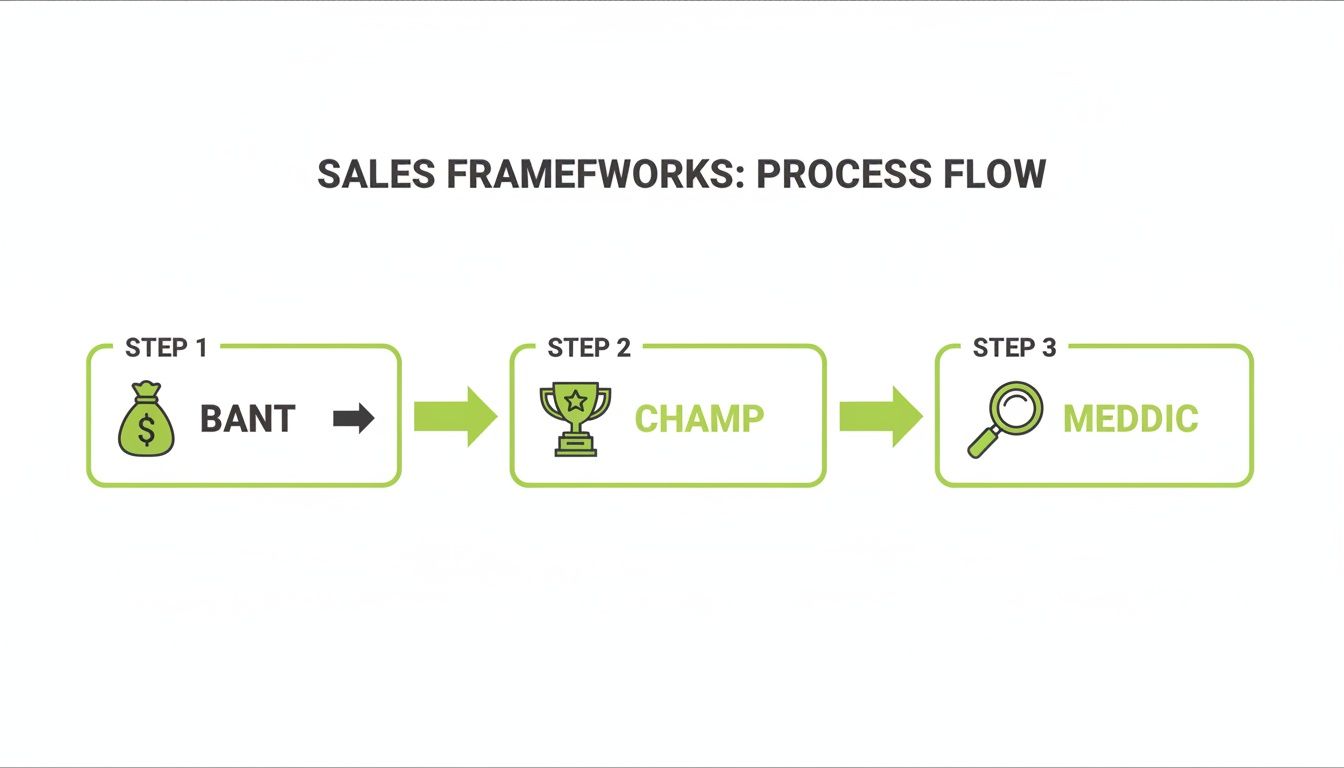
The different frameworks like BANT, CHAMP, and MEDDIC provide the structure for the questions you'll weave into this process, helping you uncover the most critical information as quickly as possible.
Handling Voice Notes and Knowing When to Call
WhatsApp isn't just text. Voice notes are a huge part of how people communicate on the platform. A prospect might send a two-minute voice note laying out their entire situation. Listening to that in real-time can kill your response speed and completely derail your momentum with other leads.
This is where your tools can make or break you. AI features that transcribe voice notes into text in seconds are a game-changer. Your reps can instantly scan the transcription for keywords related to budget, timeline, or pain points, then craft a relevant response without missing a beat.
Knowing when to jump from chat to a call is another critical skill. If the conversation gets into complex details, involves multiple decision-makers, or touches on sensitive budget numbers, a quick call is often way more efficient. Just suggest it with a customer-first approach: "This is a great question. Would you have five minutes for a quick call? It might be faster to explain over the phone."
Creating Smart Lead Handoff and Routing Rules
As leads flood in, you absolutely need a system to make sure they never go cold. Leaving a new inquiry to sit in a shared inbox is just asking to lose opportunities. A unified inbox with automated routing rules is non-negotiable for any serious sales team.
Set up simple, effective routing rules to get leads to the right person, fast. Round-robin assignment is a classic for a reason—it automatically assigns each new lead to the next available sales rep in a rotation. This keeps distribution fair and response times lightning-fast. You can also create rules based on territory, language, or product interest to route leads to the most qualified rep instantly.
By combining rapid engagement, smart use of tools, and automated routing, you build a repeatable process that turns your chaotic WhatsApp inbox into a well-oiled qualification machine. To see how this fits into the bigger picture, check out our guide on sales pipeline management best practices.
Mastering the Art of Qualifying Questions and Scripts
Knowing which framework to use is just the starting line. The real magic happens in the actual conversation, and the core of qualifying leads is all about asking the right questions at the right time. A great question can peel back layers and uncover a critical pain point, but a clumsy one? It can shut the door completely.
This is especially true on WhatsApp. Your scripts need to feel less like scripts and more like a natural conversation. They should be concise, guiding the prospect toward a solution without feeling like an interrogation. The aim is to build genuine rapport while gathering the info you need to either move the deal forward or respectfully move on.
Questions to Uncover Core Needs
Before you even think about pitching your solution, you have to get to the heart of their problem. These questions are designed to dig into their current challenges and frustrations, making them the focus. You want them to feel heard and understood.
For E-commerce: "What's the biggest headache you're dealing with in your online store's checkout process right now?"
For Real Estate: "Beyond the number of bedrooms, what's one thing your next home absolutely must have to make your daily life easier?"
For Automotive: "What's the main reason you're looking to make a switch from your current vehicle at this moment?"
These are open-ended for a reason—they invite detailed stories, not just a simple "yes" or "no." That context is gold.
Scripts for Gauging Budget and Authority
Talking about money can feel awkward, but it's a conversation you can't skip. The trick is to frame it around value and investment, not just cost. At the same time, you need to figure out if you're talking to the person who can actually sign off on the deal.
Budget Qualification Questions:
"So I can point you to the right solution, what sort of budget have you set aside for solving this problem?"
"Our solutions typically range from [Price A] to [Price B]. Does that fall in line with what you were planning to invest?"
Authority Qualification Questions:
"Besides yourself, is there anyone else on the team who'll be involved in the final decision?"
"What does your typical purchasing process look like for something like this?"
Remember, the goal isn't to put them on the spot. It's about understanding their process so you can provide the right information to the right people. This saves everyone time and prevents nasty surprises later on.
Templates for Creating Urgency
A lead might have a real need and the right budget, but if there's no urgency, that deal can sit in your pipeline forever. Your questions should help them connect their problem to real-world consequences, creating a natural reason to act now.
"What happens if this isn't sorted out in the next month? What kind of impact would that have on your business goals?"
"If we could get this up and running by [Date], what would that mean for your team's Q3 targets?"
"On a scale of 1-10, how high of a priority is finding a solution for this right now?"
These questions shift the conversation from if they should act to when and why now. Getting a handle on these conversations is key, and exploring how to properly integrate WhatsApp into your sales strategy can give you the bigger picture.
Gracefully Disqualifying a Lead
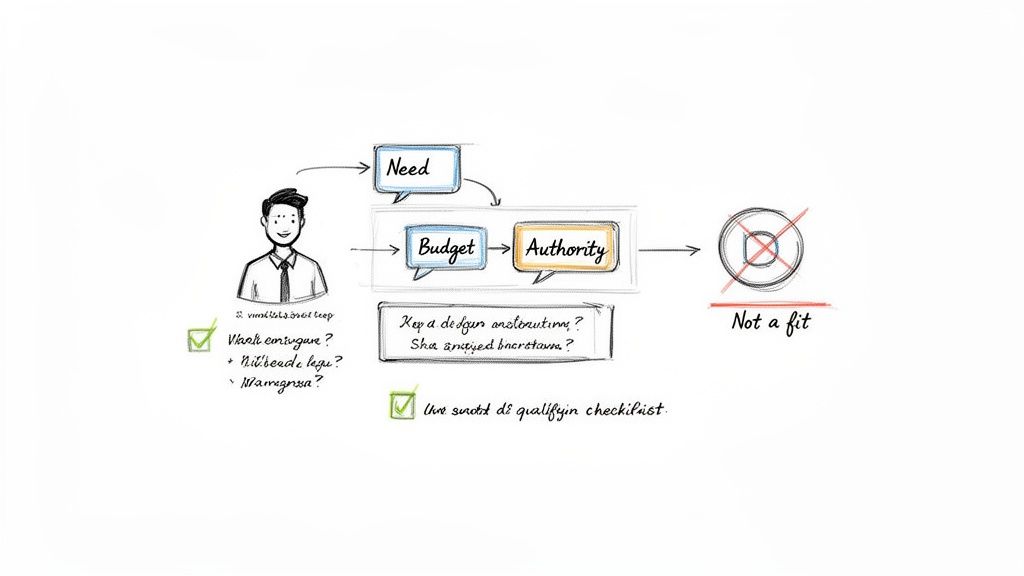
Let's be real: not every lead is a good fit. And that's okay. Knowing how to gracefully bow out is just as important as knowing how to qualify someone. It saves you valuable time and leaves the door open for the future.
Example Script:
"Thanks so much for sharing all that, [Name]. Based on what you've described, it sounds like our solution might not be the best fit for what you need right now. We really specialize in [X], and it seems you're looking for [Y]. I'd be happy to point you toward a resource that might be more helpful!"
This approach is honest, helpful, and respects their time, which goes a long way in preserving a positive impression of your brand.
Implementing Lead Scoring and Automation in Your CRM
As your business scales, so does the flood of incoming leads. Trying to manually qualify every single message is more than just inefficient—it's a recipe for burnout and missed opportunities. This is where a smart CRM, powered by lead scoring and automation, stops being a nice-to-have and becomes absolutely essential.
Without a system, your team is essentially flying blind. They're forced to chase the loudest prospects, not necessarily the most promising ones.
The numbers are pretty stark. A shocking 61% of B2B marketers send every single lead straight to sales, but only 27% of those leads are actually qualified. This disconnect is why a staggering 79% of marketing leads never convert. It's a massive waste of time and resources.
Creating Your Lead Scoring Rubric
So, how do you fix it? You start by scoring your leads. It's a simple concept: you assign points to each lead based on who they are and what they do. This gives you a numerical value that instantly tells you how sales-ready they are, allowing your reps to focus their energy where it matters most.
A solid rubric is a mix of two types of data:
Explicit Scoring: This is all about the hard facts a lead gives you. Think of it as the "who they are" data. Things like company size, job title, industry, and budget all fall into this bucket. A CEO from a target industry will obviously get more points than an intern from a sector you don't serve.
Implicit Scoring: This is where you track a lead's behavior. It's the "what they do" data that reveals their actual interest level. Did they click a link in your WhatsApp message? Are they messaging you frequently? Did they check out your pricing page? Each action is a signal of intent and should earn them points.
The real magic happens when you combine the two. A lead who perfectly fits your ideal customer profile (explicit) and is actively engaging with you (implicit) is a red-hot, sales-qualified lead (SQL) that needs immediate attention.
Building Automation Workflows in Your CRM
Once your scoring system is defined, it's time to put it to work with automation. A modern sales CRM lets you build workflows that trigger specific actions based on a lead's score or behavior. This is how you move from theory to qualifying leads at scale.
Here are a few workflows I always recommend setting up first:
Automatic Score Updates: Create rules that add or subtract points in real-time. For instance, add +10 points the moment a lead shares their budget, or +5 points for every follow-up message they send.
Hot Lead Alerts & Assignment: Define a score threshold—let's say 75 points—that automatically flips a lead to "qualified." When a lead hits that score, an automation can instantly ping a sales channel and assign them to a senior rep using a round-robin system.
Triggered Nurturing Sequences: What about leads who are warm but not quite there yet (e.g., scoring between 40-74 points)? Don't let them go cold. Trigger an automated nurturing sequence of helpful WhatsApp messages or emails designed to bump up their engagement and, consequently, their score.
A visual pipeline, like this Kanban board in Closi, is a game-changer. It organizes leads by their qualification stage, which is often tied directly to their lead score.
Each column gives sales managers an at-a-glance view of where every single opportunity stands. No more guesswork.
By automating these repetitive tasks, you empower your sales team to focus on what they were hired to do: build relationships and close deals. It's a systematic approach that ensures no high-potential lead ever slips through the cracks. If you're looking for the right platform to make this happen, check out our guide on the best lead management software.
Common Questions About Qualifying Sales Leads
Even with the best game plan, rolling out a new lead qualification process can feel like a huge change. It's totally normal for questions and a bit of hesitation to creep in, especially when you're asking a busy sales team to rethink how they work.
Let's get into some of the most common questions that pop up. These are the real-world concerns I hear all the time when teams start qualifying leads in a fast-paced world like WhatsApp.
How Can We Qualify Leads Without Slowing Down?
This is probably the biggest fear for any sales team, particularly those who live in the rapid-fire environment of WhatsApp. They worry that asking qualifying questions will add friction, slow down their response times, and maybe even cost them a lead.
But here's the reality: the exact opposite is true.
Without a qualification process, your reps are burning massive amounts of time on long, drawn-out chats that go nowhere. A smart, structured process—especially one using quick-reply templates—actually speeds up the entire sales cycle. It lets reps spot and disqualify bad-fit leads in just a few minutes, freeing up their day to pour energy into prospects who actually have a shot at closing.
Think of it this way: spending three minutes to qualify a lead is a much better use of time than spending three hours giving a demo to someone who was never going to buy anyway. Qualification doesn't slow you down; it stops you from wasting time.
A good process makes every single interaction more purposeful. Your team learns to get the info they need quickly, leading to shorter, much more productive conversations.
Will This Make Our Chats Feel Like an Interrogation?
Nobody wants to get hit with a robotic checklist of questions, especially on a personal channel like WhatsApp. The trick is to weave your qualifying questions into the conversation so it feels natural. This is about having a dialogue, not conducting a deposition.
Instead of just blasting through a list of BANT questions, train your team to use conversational segues.
Instead of: "What's your budget?"
Try: "Just so I can point you toward the right solution, what kind of investment range were you thinking for this?"
Instead of: "Are you the decision-maker?"
Try: "Awesome. Besides yourself, is there anyone else on the team who'll be involved in looking at this?"
That subtle shift in phrasing changes everything. It turns an interrogation into a consultation. Your rep goes from being a gatekeeper to a helpful guide, and the prospect feels understood, not just vetted.
How Do We Get the Whole Team to Adopt the Process?
Trying to roll out a new process without getting your team's buy-in is a recipe for disaster. If your reps don't see the point, they'll fall back on old habits the second they get busy. Getting them on board is all about a smart mix of training, the right tools, and clear incentives.
Here's a practical way to get everyone to adopt the new process:
Show Them the "Why": Start with the numbers. Show them exactly how much time is being torched on unqualified leads and how that directly hits their commissions and the company's bottom line.
Make It Ridiculously Easy: This is non-negotiable. Give them tools that make their lives easier, like a CRM with pre-built quick reply templates and lead scoring that happens automatically. If the new way is simpler than the old way, they'll use it.
Give Them the Words: Don't just hand them a framework; give them the actual scripts. Offer up sample questions and message templates they can use right on WhatsApp for different situations.
Reward Quality, Not Just Quantity: Tweak your team's KPIs. Instead of just tracking how many chats they have, start rewarding them for metrics like the number of sales-qualified leads (SQLs) they generate or their conversion rate from lead to opportunity. When their paycheck is tied to the quality of qualification, you'll see adoption happen overnight.
At the end of the day, a successful rollout isn't about giving your team a manual. It's about proving to them that qualifying leads will help them close more deals and, ultimately, make more money.
Stop letting valuable leads slip through the cracks in scattered WhatsApp chats. With Closi, you can centralize your conversations, automate your qualification process, and give your sales team the tools they need to focus on closing deals. See how Closi can transform your WhatsApp sales today.
Frequently Asked Questions
Have a question not in here? Contact us
- How Can We Qualify Leads Without Slowing Down?
This is probably the biggest fear for any sales team, particularly those who live in the rapid-fire environment of WhatsApp. They worry that asking qualifying questions will add friction, slow down their response times, and maybe even cost them a lead. But here's the reality: the exact opposite is true. Without a qualification process, your reps are burning massive amounts of time on long, drawn-out chats that go nowhere. A smart, structured process—especially one using quick-reply templates—actually speeds up the entire sales cycle.
- Will This Make Our Chats Feel Like an Interrogation?
Nobody wants to get hit with a robotic checklist of questions, especially on a personal channel like WhatsApp. The trick is to weave your qualifying questions into the conversation so it feels natural. This is about having a dialogue, not conducting a deposition. Instead of just blasting through a list of BANT questions, train your team to use conversational segues.
- How Do We Get the Whole Team to Adopt the Process?
Trying to roll out a new process without getting your team's buy-in is a recipe for disaster. If your reps don't see the point, they'll fall back on old habits the second they get busy. Getting them on board is all about a smart mix of training, the right tools, and clear incentives. Show them the numbers, make it ridiculously easy, give them the actual scripts, and reward quality over quantity.
- What's the difference between BANT, CHAMP, and MEDDIC frameworks?
BANT (Budget, Authority, Need, Timeline) works best for simple products and shorter sales cycles. CHAMP (Challenges, Authority, Money, Prioritization) is more customer-centric and perfect for consultative sales. MEDDIC (Metrics, Economic Buyer, Decision Criteria, Decision Process, Identify Pain, Champion) is designed for complex enterprise deals with longer sales cycles and multiple stakeholders.